
Image editing, inpainting and outpainting
Generating an image from nothing is the easy problem. Changing one you already have is harder, because success now has two requirements that pull against each other: the edit must happen, and everything else must stay exactly as it was. This page covers the five mechanisms the field actually uses, treats inpainting and outpainting properly, and is blunt about the fact that the central obstacle to progress here is evaluation, not generation.
Symbols used on this page are defined in the Nomenclature → learning.
The latent-diffusion machinery underneath — the forward and reverse processes, classifier-free guidance, the VAE and the 9-channel inpainting UNet — is derived on the Stable Diffusion page and is not repeated here. This page is about control.
1 · Five mechanisms
| Mechanism | What the user supplies | How the constraint is imposed | Locality | Representative |
|---|---|---|---|---|
| 1 · Mask-based | Image + mask + prompt | Hard — pixels outside the mask are copied | Guaranteed | SD inpainting, FLUX Fill |
| 2 · Attention control | Image + two prompts | Reuse or inject cross-attention maps from the source generation | Soft | Prompt-to-Prompt, MasaCtrl |
| 3 · Inversion-based | Real image + prompts | Recover the noise that would generate the image, then re-denoise with a new prompt | Soft | DDIM inversion, Null-text, pix2pix-zero |
| 4 · Instruction-tuned | Image + plain instruction | Learned from synthetic (before, after, instruction) triples | Learned, not enforced | InstructPix2Pix, MagicBrush, Emu Edit |
| 5 · Structural / in-context | Image + reference or control signal | Extra conditioning branch, or the reference as context tokens | Structural | ControlNet, IP-Adapter, FLUX Kontext |
2 · Inpainting — the mask-based mechanism
The naive approach is to blend in latent space at every denoising step: run the normal reverse process, but after each step overwrite the unmasked region with a correctly-noised copy of the original.
$$ \mathbf z_{t-1} \;\leftarrow\; \underbrace{\mathbf m \odot \mathbf z^{\text{gen}}_{t-1}}_{\text{generated, inside}} \;+\; \underbrace{(1-\mathbf m) \odot \mathbf z^{\text{orig}}_{t-1}}_{\text{known, outside}}, \qquad \mathbf z^{\text{orig}}_{t-1} = \sqrt{\bar\alpha_{t-1}}\,\mathbf z_0 + \sqrt{1-\bar\alpha_{t-1}}\,\boldsymbol\epsilon $$This works, and it needs no training — but it has a characteristic failure: the model inside the mask only learns about the outside through the blend, not through the network, so it tends to produce something plausible in isolation that does not match its surroundings. Seams and lighting mismatches are the signature.
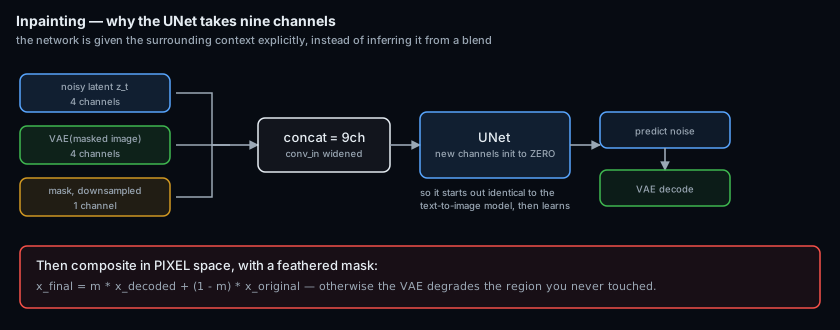
2.1 The trained alternative: a 9-channel UNet
A dedicated inpainting model gives the network the context explicitly, by widening its first convolution:
| Channels | Content |
|---|---|
| 4 | The noisy latent being denoised, as usual |
| 4 | The masked image, VAE-encoded — what is actually around the hole |
| 1 | The mask, downsampled to latent resolution |
The checkpoint is initialised from the text-to-image weights with the five new channels zeroed, so it starts out behaving exactly like the base model and learns to use the new inputs. Training uses (image, mask, prompt) triples with randomly generated masks — and the mask distribution matters: train only on small rectangles and the model will not handle a large irregular region.
3 · Outpainting — the same mechanism, a harder problem
Outpainting is inpainting with the mask inverted: the known region is the original image and the unknown region is new canvas around it. Mechanically identical, substantially harder, for three reasons.
| Difficulty | Why it is specific to outpainting | Mitigation |
|---|---|---|
| One-sided context | An inpainted hole is surrounded by evidence. An outpainted margin has context on one side only, so the problem is far less constrained | Expand in small increments rather than one large jump |
| Error accumulation | Iterative expansion conditions each step on the previous generation, not on real pixels. Drift compounds — colour, style and perspective wander | Re-anchor on the original at every step; keep the original visible in context |
| Global geometry | Extending a building requires a consistent vanishing point the model has no explicit representation of | Depth or line conditioning via ControlNet |
4 · Instruction-based editing
Masks are precise and tedious. The instruction-based line removes them: the user says "make it winter" and the model works out what to change. The problem is training data — there is no natural corpus of (before, after, instruction) triples.
InstructPix2Pix's solution was to synthesise the dataset using two existing models, which is worth understanding because the whole line inherits its properties:
Because the model is conditioned on both an image and a text instruction, it needs two guidance scales — one controlling instruction adherence, one controlling faithfulness to the input:
$$ \tilde{\boldsymbol\epsilon} = \boldsymbol\epsilon_\varnothing + s_I\big(\boldsymbol\epsilon(\mathbf c_I) - \boldsymbol\epsilon_\varnothing\big) + s_T\big(\boldsymbol\epsilon(\mathbf c_I, \mathbf c_T) - \boldsymbol\epsilon(\mathbf c_I)\big) $$with $s_I$ the image scale and $s_T$ the text scale. Tuning these is the locality/fidelity trade, exposed as two knobs: raise $s_T$ and the edit is applied aggressively but the image drifts; raise $s_I$ and the image is preserved but the instruction may be ignored.
5 · Inversion — editing a real photograph
Attention-control methods need the attention maps from the image's generation, which you do not have for a real photograph. Inversion recovers them by running the sampler backwards to find the noise that would have produced this image. DDIM is deterministic, so it can be reversed:
$$ \mathbf z_{t+1} = \sqrt{\frac{\bar\alpha_{t+1}}{\bar\alpha_t}}\,\mathbf z_t + \left(\sqrt{1-\bar\alpha_{t+1}} - \sqrt{\frac{\bar\alpha_{t+1}(1-\bar\alpha_t)}{\bar\alpha_t}}\right) \boldsymbol\epsilon_\theta(\mathbf z_t, t, \mathbf c) $$| Method | Fix | Cost |
|---|---|---|
| Null-text inversion | Optimise the unconditional embedding per timestep so the guided trajectory reproduces the image | Per-image optimisation — minutes |
| Negative-prompt inversion | Set the null embedding to the source prompt analytically instead of optimising | Nearly free; slightly worse |
| pix2pix-zero | Compute a direction in text-embedding space and regularise cross-attention toward the source | No per-image training |
| Rectified-flow inversion | Straight ODE paths invert far more stably — a real advantage of SD3/FLUX | Cheap, and the current best option |
6 · Structural and reference conditioning
| Method | Mechanism | Preserves |
|---|---|---|
| ControlNet | A trainable copy of the encoder half takes a control image (Canny, depth, pose, segmentation) and injects features through zero-initialised convolutions | Geometry and structure, while style changes freely |
| T2I-Adapter | Same goal, a much smaller side network | As above, cheaper, slightly weaker |
| IP-Adapter | Decoupled cross-attention: a separate attention path for image-prompt tokens | Identity or style from a reference image |
| LoRA / DreamBooth | Fine-tune on a few images of a subject | A specific subject's identity across any prompt |
| In-context (FLUX Kontext) | Feed the reference image as context tokens alongside the instruction | Character and scene consistency without per-subject training |
7 · The locality–fidelity trade
Every mechanism above lands somewhere on one axis: how strongly the unedited region is protected.
| Symptom | Likely cause | Try |
|---|---|---|
| The edit did not happen | Image guidance too high, or denoising strength too low | Raise $s_T$, raise strength, make the instruction more explicit |
| The whole image changed | Text guidance too high; no locality constraint | Lower $s_T$, add a mask, switch to a mask-based method |
| Visible seam at the mask edge | Hard mask boundary, latent/pixel resolution mismatch | Feather the mask; composite in pixel space; blur at latent resolution |
| Identity lost ("same person, different face") | No identity conditioning | IP-Adapter or a subject LoRA |
| Lighting inconsistent with the scene | The inpainted region was generated without enough surrounding context | Use the trained inpainting model, not latent blending; widen the context crop |
| Outpainted region drifts in style | Conditioning on previous generations | Re-anchor on the original every step; smaller increments |
8 · Evaluation — the actual bottleneck
There is no ground truth for "make it winter". That single fact is why editing research is harder to assess than VQA, and why progress is hard to verify.
| Metric | Measures | How it misleads |
|---|---|---|
| CLIP score | Output–prompt similarity | Satisfied by ignoring the input image entirely and generating the target from scratch |
| Directional CLIP | Whether the image changed in the same direction as the caption change | Better, since it uses both images — but still CLIP, so blind to the word-order and compositional failures of §CLIP |
| LPIPS / L1 to input | How little changed | Minimised by doing nothing. Meaningless unless paired with an edit-success term |
| FID | Distributional realism | Needs thousands of images; says nothing about whether this edit was right |
| Human preference | What we actually care about | Expensive, noisy, unreproducible across studies |
| VLM-as-judge | Ask a strong VLM whether the edit was performed | Promising, and inherits every hallucination problem from VQA §5 |
9 · Practical summary
- If you can draw a mask, draw one. A hard constraint beats a learned one, and the trained 9-channel model beats latent blending.
- Always composite back in pixel space with a feathered mask. Otherwise the VAE degrades the untouched region.
- Outpaint in small steps, re-anchored on the original, or style will drift.
- For real photographs, prefer a rectified-flow model — inversion is markedly more stable than with DDIM plus guidance.
- Two guidance scales, two failure modes. Nothing changed → raise $s_T$. Everything changed → raise $s_I$ or add a mask.
- Report a curve, not a point. Any single editing metric can be gamed by a degenerate strategy.
10 · References
The figures on this page are original redrawings in the site's palette, not reproductions — the architectures are credited to the papers below. Where a blog post is the clearest explanation of something, it is cited as such.
10.1 Editing mechanisms
- Meng et al., SDEdit (ICLR 2022) — the noise-and-denoise basis of img2img.
- Lugmayr et al., RePaint (CVPR 2022) — the latent-blending inpainting scheme in §2.
- Hertz et al., Prompt-to-Prompt Image Editing with Cross Attention Control (ICLR 2023).
- Brooks et al., InstructPix2Pix (CVPR 2023) — including the synthetic-triple generation discussed in §4.
- Zhang et al., MagicBrush (NeurIPS 2023); Sheynin et al., Emu Edit (CVPR 2024).
- Mokady et al., Null-text Inversion for Editing Real Images (CVPR 2023); Parmar et al., pix2pix-zero (SIGGRAPH 2023).
- Zhang et al., Adding Conditional Control to Text-to-Image Diffusion Models (ControlNet, ICCV 2023).
- Ye et al., IP-Adapter (2023); Ruiz et al., DreamBooth (CVPR 2023); Hu et al., LoRA (ICLR 2022).
10.2 Evaluation
- Gal et al., StyleGAN-NADA (2021) — the origin of the directional CLIP loss.
- Basu et al., EditVal (2023); Ku et al., ImagenHub (ICLR 2024) — standardised editing evaluation, and honest about how unsettled it is.
- Hessel et al., CLIPScore (EMNLP 2021) — and read §8 here for how it is gamed.
Related: Model comparison table · Architecture modules · Visual question answering · Open problems · Stable Diffusion deep dive · GroundingDINO (masks from text)