
GRPO — group relative policy optimisation
GRPO (Shao et al., 2024, DeepSeekMath) is PPO with the critic removed. Instead of learning $V(s)$, it samples a group of $G$ completions for the same prompt, scores each one, and uses the z-score of each score within its group as the advantage. It was designed for language models and is the algorithm behind DeepSeek-R1. This page derives it, ports it as faithfully as possible to LunarLander, and reports honestly what happened: it did not solve the task. The reason it failed explains why it works so well for LLMs.
Background: PPO's clipped surrogate is derived on the PPO page and the baseline argument on the RL overview. The LLM side (RLHF, Dr. GRPO, DPO) is on PPO & GRPO for LLMs. An applied GRPO run with an SQL execution reward is in the LLMs & SQL-GRPO track. Numbers marked measured are from 5 seeds on this machine.
1 · The objective
1.1 Group-relative advantage
For a prompt $q$, sample $G$ outputs $o_1,\dots,o_G \sim \pi_{\theta_\text{old}}(\cdot\mid q)$ and score each with a scalar reward $r_i$. Under outcome supervision, the paper's default, every token $t$ of output $i$ gets the same advantage:
$$ \hat A_{i,t} = \tilde r_i = \frac{r_i - \operatorname{mean}(r_1,\dots,r_G)}{\operatorname{std}(r_1,\dots,r_G)} \tag{1} $$Why this is a sensible advantage follows from the baseline argument (overview 8–9). The group mean is a Monte-Carlo estimate of $V^{\pi_\text{old}}(q)$, the expected reward from this prompt, computed from samples instead of a learned network. Subtracting it is a baseline. Dividing by the group std is a per-prompt version of PPO's advantage normalisation: it makes easy prompts (where all outputs score similarly) and hard prompts contribute gradients of comparable size. Two technical notes. Including $r_i$ in its own mean couples the baseline to the sample: since $r_i - \operatorname{mean}_j r_j = \tfrac{G-1}{G}\big(r_i - \operatorname{mean}_{j\ne i} r_j\big)$, the expected gradient is the leave-one-out (RLOO) one scaled by $(G-1)/G$, a change of scale rather than of direction. And the std division is not unbiased either, which is one of the Dr. GRPO criticisms (LLM page).
1.2 PPO's clip, no critic, KL in the loss
The objective maximised (DeepSeekMath eq. 3), with $\rho_{i,t} = \pi_\theta(o_{i,t}\mid q, o_{i,\lt t}) / \pi_{\theta_\text{old}}(o_{i,t}\mid q, o_{i,\lt t})$:
$$ \mathcal J_\text{GRPO}(\theta) = \frac{1}{G}\sum_{i=1}^{G}\frac{1}{|o_i|}\sum_{t=1}^{|o_i|} \Big\{\min\Big(\rho_{i,t}\hat A_{i,t},\ \operatorname{clip}(\rho_{i,t}, 1-\epsilon, 1+\epsilon)\,\hat A_{i,t}\Big) - \beta\, \mathbb{D}_\mathrm{KL}\big[\pi_\theta\Vert\pi_\text{ref}\big]_{i,t}\Big\} \tag{2} $$Three differences from PPO. There is no value network: the advantage is (1). The KL to a reference policy $\pi_\text{ref}$ (for an LLM, the SFT model) is a term in the loss, whereas InstructGPT-style PPO puts it in the reward. And there is a per-sequence length normalisation $1/|o_i|$, with $|o_i|$ the number of tokens, so each output contributes equally to the average, however long it is.
2 · The KL estimator, derived
The per-token KL in (2) is estimated at the sampled token with (DeepSeekMath eq. 4):
$$ \mathbb{D}_\mathrm{KL}\big[\pi_\theta\Vert\pi_\text{ref}\big]_{i,t} \approx \frac{\pi_\text{ref}(o_{i,t}\mid\cdot)}{\pi_\theta(o_{i,t}\mid\cdot)} - \log\frac{\pi_\text{ref}(o_{i,t}\mid\cdot)}{\pi_\theta(o_{i,t}\mid\cdot)} - 1 \tag{3} $$Write $x = \pi_\text{ref}(a)/\pi_\theta(a)$ for a single action (token) $a$ drawn from $\pi_\theta$.
Unbiased. The first term has expectation one: $\mathbb{E}_{a\sim\pi_\theta}[x] = \sum_a \pi_\theta(a)\,\pi_\text{ref}(a)/\pi_\theta(a) = \sum_a\pi_\text{ref}(a) = 1$ (assuming $\pi_\text{ref}$'s support is inside $\pi_\theta$'s). So
$$ \mathbb{E}_{a\sim\pi_\theta}\big[x - \log x - 1\big] = 1 - \mathbb{E}_{\pi_\theta}\Big[\log\frac{\pi_\text{ref}(a)}{\pi_\theta(a)}\Big] - 1 = \mathbb{E}_{\pi_\theta}\Big[\log\frac{\pi_\theta(a)}{\pi_\text{ref}(a)}\Big] = D_\mathrm{KL}(\pi_\theta\Vert\pi_\text{ref}) \tag{4} $$Non-negative, sample by sample. Let $f(x) = x - \log x - 1$ on $x \gt 0$. Then $f'(x) = 1 - 1/x$ is zero only at $x = 1$, and $f''(x) = 1/x^2 \gt 0$, so $x = 1$ is the global minimum and $f(1) = 0$. Hence $f(x) \ge 0$, which is the familiar $\log x \le x - 1$. The naive estimator $-\log x$ (k1) is also unbiased, but it is negative whenever the sampled token is more likely under the reference, which makes a single-sample penalty noisy and sometimes a reward. Adding the zero-mean control variate $x - 1$ removes that without changing the expectation. It is the same k3 construction PPO uses for its diagnostic (PPO §4.1), applied to the opposite KL direction with the reference in the numerator.
3 · Outcome versus process supervision
- Outcome supervision: one reward per output, broadcast to every token, eq. (1). This is the default, and it is what was run here.
- Process supervision: a process reward model scores each reasoning step. Rewards are group-normalised across all steps of all outputs, and the advantage of token $t$ is the sum of normalised rewards of the steps at or after it, $\hat A_{i,t} = \sum_{\text{index}(j)\ge t}\tilde r_i^{\,\text{index}(j)}$. This restores per-step credit assignment, at the cost of needing per-step rewards. Not run here; see §6.
4 · The port to LunarLander, exactly
| LLM (DeepSeekMath) | LunarLander (grpo.py) |
|---|---|
| Prompt $q$ | A reset seed. env.reset(seed=q) fixes the terrain and the random initial push. Two envs
reset with the same seed and fed the same 300 actions were verified to differ by exactly 0.0, so "same prompt" is exact. |
| $G$ completions $o_1..o_G$ | $G = 16$ complete episodes from that same initial state, actions sampled from $\pi_{\theta_\text{old}}$ |
| Token $o_{i,t}$ | Action $a_{i,t} \in \{0,1,2,3\}$ |
| Reward-model score $r_i$ | Undiscounted episode return $R_i = \sum_t r_{i,t}$ |
| Advantage | $(R_i - \operatorname{mean}_g R)/(\operatorname{std}_g R + 10^{-4})$, broadcast to every step of episode $i$ |
| $1/|o_i|$ | Per-step weight $\propto 1/L_i$, with $L_i$ the episode length |
| $\pi_\text{ref}$ = SFT model | A copy of the policy, refreshed $\pi_\text{ref}\leftarrow\pi_\theta$ every 10 iterations (iterative GRPO) |
| No value model | No value model. Only the 4,996-parameter actor is trained. |
Each iteration draws 4 prompts × 16 samples = 64 episodes. The core of the update:
4.1 Choices that had to be made
| Parameter | Value | Why |
|---|---|---|
| $G$ | 16 | DeepSeekMath uses 64. 16 keeps one iteration at or below 64k steps |
| Prompts / iteration | 4 | 64 episodes per iteration |
| Clip $\epsilon$, epochs, minibatch, lr, grad clip | 0.2, 4, 64, Adam 3e-4, 0.5 | Identical to PPO, so the comparison isolates "critic + GAE" vs "group-relative outcome reward" |
| $\beta$ | 0.04 | Paper value |
| Reference refresh | every 10 iterations | A frozen $\pi_\text{ref}$ would pin a from-scratch policy to its random initialisation. An SFT'd LLM does not have that problem |
| Entropy bonus, discount | 0, none | The paper has neither. Outcome reward is the plain episode return |
Note what the length normalisation does here. A 70-step crash and a 1,000-step hover each contribute the same total weight to the loss. Per step, the crash's actions are weighted about 14× more heavily.
4.2 Training loop, step by step
Line (b) is the whole difference from PPO. Where PPO computes a different $\hat A_t$ for every one of its 16,384 steps from what the critic expected at that state, GRPO computes 64 numbers and copies each one hundreds of times. Everything after that, the ratio, the clip and the epochs, is PPO's code unchanged, by design, so that the comparison isolates the advantage.
4.3 Inference
For PPO the two branches of this listing give the same controller to within a few points. For GRPO they do not, and §5.2 measures the gap.
5 · Results: it did not solve (measured)
| seed 0 | seed 1 | seed 2 | seed 3 | seed 4 | Summary | |
|---|---|---|---|---|---|---|
| Final policy, deterministic (argmax), 50 eps | 22.5 | −126.9 | 40.5 | −3.0 | −1,877.5 | −388.9 ± 746.6 (−16.7 ± 63.3 excl. seed 4); 2.0 % solved |
best.pt, deterministic, 50 eps | 77.8 | −18.4 | 86.3 | 136.2 | −26.8 | 51.0 ± 61.0 |
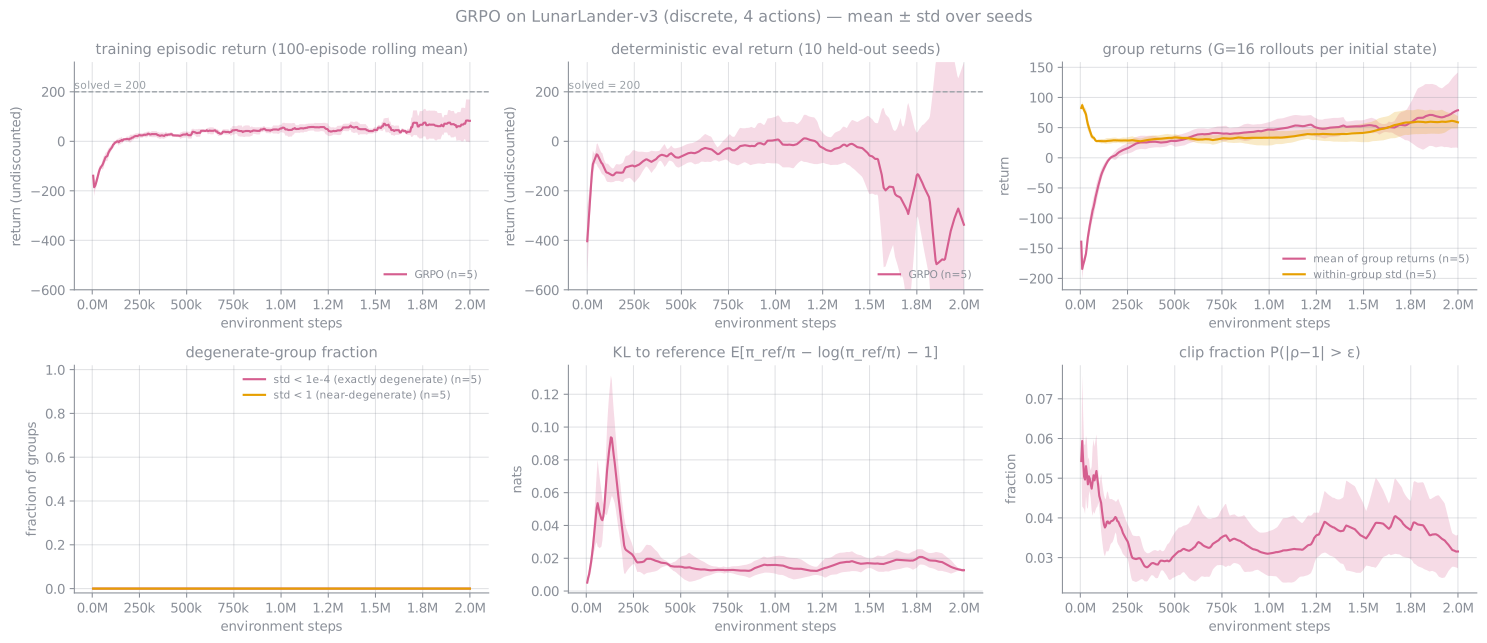
No seed's periodic evaluation ever reached 200. Only 74–79 policy iterations fitted in 2M steps, because each iteration costs 64 complete episodes, up to 64k steps once the policy hovers. PPO gets 123 rollouts from the same budget. Wall-clock 743 s per seed. KL to the reference: median 0.013–0.019, max 0.119–0.167. Clip fraction median 0.028–0.042, max 0.071–0.101. So the optimisation itself was well-behaved.
5.1 Degenerate groups were not the problem
The standard worry about GRPO is degenerate groups: if all $G$ outputs get the same reward, the std in (1)
is zero, every advantage is zero, and the prompt contributes no learning signal. That is common for LLMs on prompts
that are far too easy or far too hard. grpo.py logs the fraction of groups with std below $10^{-4}$
(exactly degenerate) and below 1.0 (returns within about one reward point):
both were 0.00 in every iteration of every seed. Sixteen episodes from a stochastic policy always spread out in
LunarLander, with a within-group return std of 41–82 at the end of training. The signal was there. It was the
wrong kind of signal.
5.2 The real failure: the policy never sharpens
The final policies were evaluated on the same 50 held-out seeds both ways (eval_stochastic.py):
| Config | Deterministic (argmax, shipped) | Sampled (the policy it trained as) | Policy entropy at start states |
|---|---|---|---|
| PPO | 273–280 | 269–279 | 0.27–0.44 |
| A2C | −120 … +50 | −118 … +62 | 0.08–0.24 |
| GRPO | −1,878 … +41 | +31 … +234 (seed 1: 94 % solved) | 0.97–1.21 (max ln 4 = 1.39) |
For PPO and A2C, argmax and sampling agree, because their policies became confident (low entropy). GRPO's did not. Its action distribution at the start states stays at 0.97–1.21 nats, close to uniform. Its sampled policy really did learn: seed 1's solves 94 % of the final evaluation seeds. But the argmax of a near-flat distribution is a different controller. It picks whichever action is marginally ahead in each state, consistently, with none of the mixing that made the stochastic policy work. Seed 4 is the extreme case: its sampled policy scores +65, while its argmax fires one engine continuously and scores −1,877 (−2,411 at 1.9M steps, flying out of bounds).
5.3 The best GRPO controller, flown
best.pt, deterministic (argmax) policy, recorded on this machine. Flown on a pool of 24
held-out video seeds (3,000,000,000 onward): only 3 / 24 score ≥ 200 (13 landed, 2 crashed, 9 timed out). The
video shows all three successes (233, 212, 210, all landed) and then, because more than 15 % failed, the first pool
episode below 200. That one is a slow 118-point landing, not a crash. 640×400 H.264, 56.0 s. The success
rate is printed on the video's stats panel.
5.4 Learning progression from the same starts
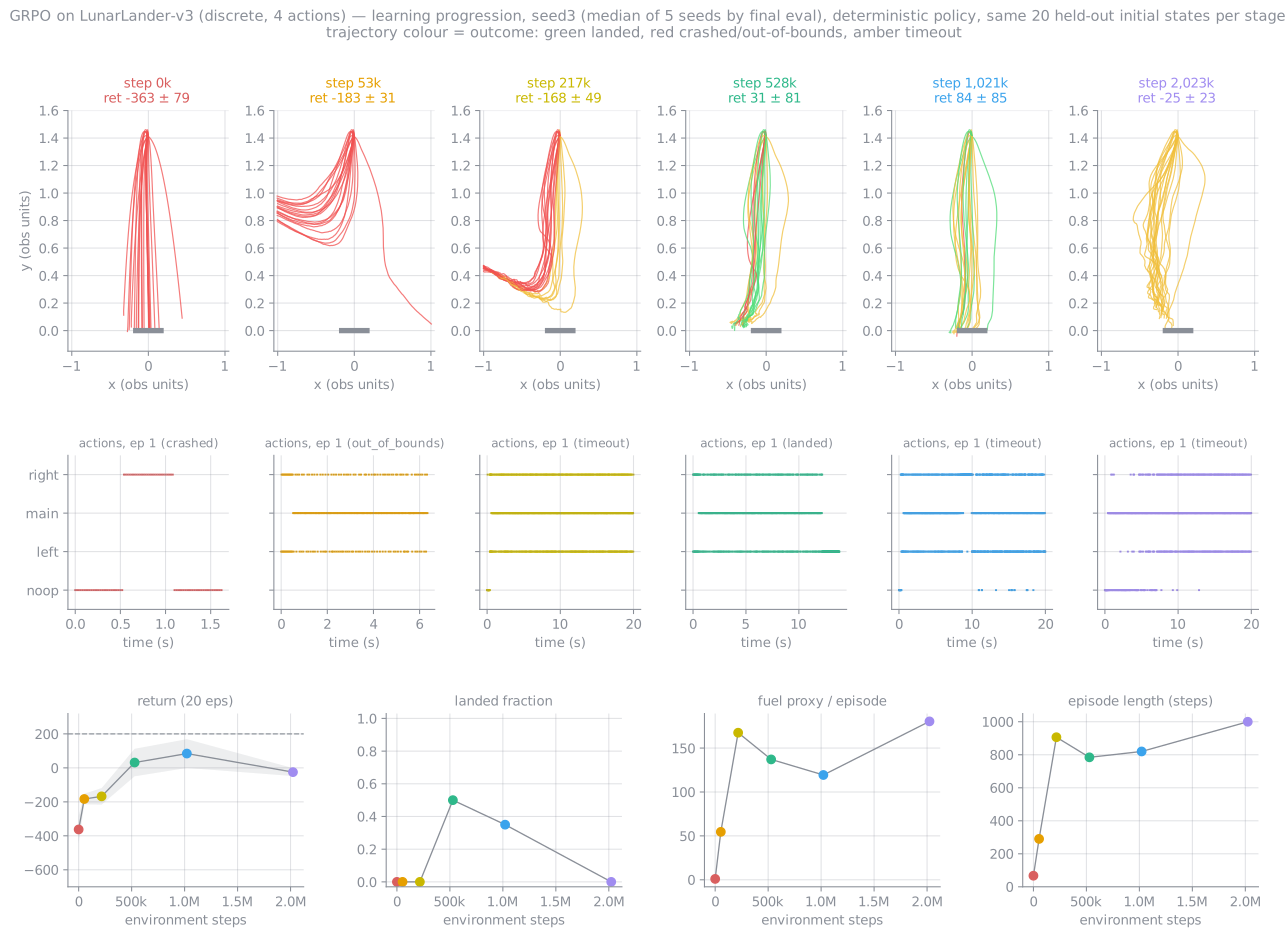
Median seed by final eval (seed 3), deterministic, the same 20 held-out initial states. Mean return / fraction landed: −363 / 0 % → −183 / 0 % → −168 / 0 % → 31 / 50 % → 84 / 35 % → −25 / 0 % at 0 / 2.5 / 10 / 25 / 50 / 100 %. At the end, 100 % of those episodes time out: the argmax controller has learned to hover, not to land. Fuel use stays high (75–180 on the fuel proxy), while PPO's falls to 31.
6 · Why GRPO suits LLMs and this setup does not suit GRPO
| Ingredient | LLM (math, code, SQL) | LunarLander, from scratch |
|---|---|---|
| Natural reward granularity | One reward per completion is the natural signal: the answer is right or wrong, the SQL returns the right rows or not. No dense signal is being thrown away. | A dense, shaped per-step reward exists (overview 15). Outcome supervision discards it. |
| Prior | A strong pretrained, SFT'd prior. Sampled completions are already near-deterministic yet varied, so RL only needs to reweight good modes the model can already produce. | A random 4,996-parameter MLP with a near-uniform policy. RL must discover the behaviour, which needs per-step credit. |
| Cost of $G$ samples | Cheap: $G$ completions of one prompt batch on a GPU, sharing the prompt's KV-cache. No value model saves a full model copy in memory (LLM page). | Expensive: 64 complete episodes per iteration, so only 74–79 iterations fit in 2M steps. |
| Mode at deployment | Usually sampled, or greedy from an already peaked distribution. | Argmax of a near-flat distribution, which is a different controller (§5.2). |
| What a critic costs | A second multi-billion-parameter model, hard to train on sparse terminal rewards. | 4,801 parameters. Trivially cheap, and it explains 94–99 % of return variance for PPO. |
In short: GRPO removes the critic because, for an LLM, the critic is expensive and nearly useless. Rewards are terminal, and the pretrained policy already concentrates its probability mass. For a from-scratch controller with dense rewards, the critic is cheap and is exactly what supplies per-step credit. Removing it removes the thing that would have sharpened the policy.
7 · Honest limitations of this experiment
- Reference configuration, not tuned. GRPO was deliberately not tuned until it beat PPO. Larger $G$, more prompts per iteration, an entropy schedule, or deploying the sampled policy would all likely look better.
- Process supervision was not run. A per-step variant using the env's shaped reward, normalised across the group's steps as in §3, is the obvious next experiment. It would partly restore the per-step credit whose absence §5.2 identifies.
- The reference schedule is a choice. Refreshing $\pi_\text{ref}$ every 10 iterations makes the KL term a slowly moving trust region rather than an anchor to a meaningful prior. That is necessary from scratch, but it is not how the term is used for LLMs.
- The causal story is inferred. The entropy and stochastic-vs-deterministic numbers are consistent with the credit-assignment explanation, but a controlled ablation (GRPO with a per-step advantage) was not run.
8 · References
- Shao, Wang, Zhu, Xu, Song, Bi, Zhang, Zhang, Li, Wu, Guo, DeepSeekMath: Pushing the Limits of Mathematical Reasoning in Open Language Models, arXiv:2402.03300, 2024. §4.1, eqs. (3)–(4).
- DeepSeek-AI, DeepSeek-R1: Incentivizing Reasoning Capability in LLMs via Reinforcement Learning, arXiv:2501.12948, 2025.
- Schulman, Approximating KL Divergence, 2020. The k3 estimator.
- Liu et al., Understanding R1-Zero-Like Training: A Critical Perspective (Dr. GRPO), arXiv:2503.20783, 2025.
- Ahmadian et al., Back to Basics: Revisiting REINFORCE Style Optimization for Learning from Human Feedback in LLMs (RLOO), ACL 2024.
Next: PPO & GRPO for LLMs · applied: LLMs & SQL-GRPO · PPO · back to the RL overview